





Super Rhinox Semi Trailer Wheels & Rims: The Complete Buyer's Guide for Fleets and Trailer Builders
 Oct 10, 2026|
 View:7
Super Rhinox Semi Trailer Wheels & Rims: The Complete Buyer's Guide for Fleets and Trailer Builders
A practical fitment, material, sizing and maintenance reference for fleet managers, OEM trailer builders and parts distributors.
When fleet managers, trailer manufacturers, and parts distributors talk about semi trailer wheels, they are rarely talking about just one component. In the heavy-transport world, the term can mean the complete wheel-and-tire assembly, while semi trailer rims and trailer wheel rims usually refer to the metal disc that carries the tire, mounts to the hub, and transfers every kilogram of payload from the road back to the axle.
Super Rhinox supplies trailer-specific wheel solutions for semi-trailers, flatbeds, reefers, tankers, curtain-side trailers, boat transporters, and heavy utility equipment. Whether you run tubeless 22.5-inch steel wheels across a triple-axle fleet or want polished aluminum trailer wheel rims to cut weight and improve resale value, the fundamentals are the same: correct fitment, verified load rating, and a rim built for the hub—not just the tire.
Open the product page in a new tab to check sizes, materials and specifications.
Semi Trailer Wheels vs Semi Trailer Rims
A semi trailer wheel is often used loosely to describe the rim plus tire. A semi trailer rim is the bare steel or aluminum disc—no rubber. Trailer wheel rims is the catalog phrase many international buyers use when searching for replacement 22.5-inch tubeless wheels, 9.0-22.5 rims, 8.25-22.5 rims, or 11.75-22.5 super-single compatible designs.
For heavy semi-trailers, 22.5-inch rims are the global workhorse. They pair with 11R22.5, 295/75R22.5, 315/80R22.5, and 385/65R22.5 tires, and they match the drum brakes, hub pilots, and stud configurations used on 9-ton, 10-ton, and 13-ton axle systems.
Why Rim Specs Matter More Than Diameter
Choosing semi trailer rims by diameter alone is the most expensive mistake in trailer spec'ing. A 22.5-inch rim still will not fit if the bolt pattern, pilot bore, offset, seat style, or load rating is wrong.
Key fitment checks
Bolt pattern / PCD — heavy semi-trailers commonly use 10 × 285.75 mm hub-piloted wheels; older or region-specific hubs may use different circles.
Center bore / pilot diameter — hub-piloted 22.5 wheels often use about 220.1 mm bore.
Stud size and nut style — hub-piloted systems use flat-seat flange nuts; stud-piloted "Budd" wheels use conical/bevel seats.
Rim width — 7.50, 8.25, 9.00, 11.75, and 12.25 widths change tire support, sidewall angle, and load behavior.
Load rating — the rim itself has a rated capacity independent of the tire.
Material — steel for toughness and low cost; aluminum alloy for weight savings, heat dissipation, and appearance.
Super Rhinox stocks durable steel rims and lightweight aluminum alloy rims, with multiple lug configurations and trailer-specific geometries for commercial and specialty applications.
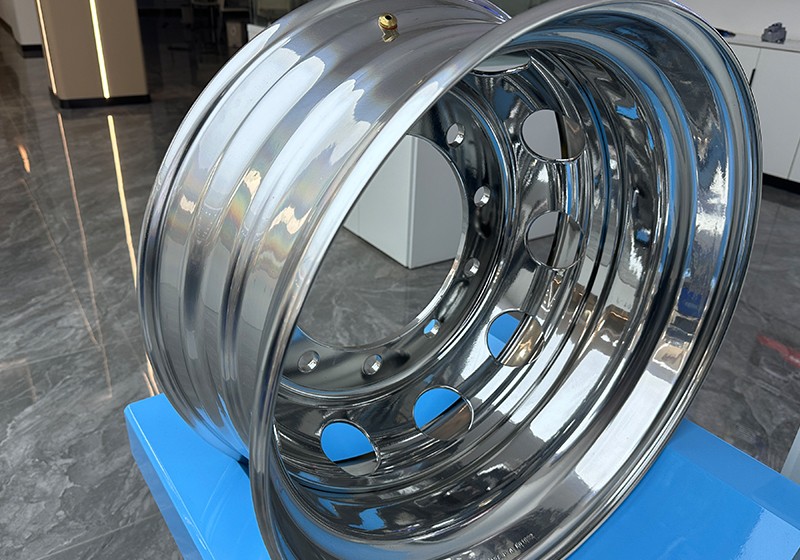
Steel vs Aluminum Trailer Wheel Rims
Steel semi trailer rims remain the default for general cargo, tippers, construction trailers, and rough-yard operations. They resist impact, cost less upfront, and are easy to keep in service.
Aluminum trailer wheel rims are lighter—often 15–20 kg less per wheel than steel—which improves payload, reduces unsprung weight, dissipates brake heat faster, and gives fleets a premium look. For long-haul operators, the weight saving across 6, 8, or 12 wheel positions can improve fuel economy and tire life.
Super Rhinox aluminum rims are finished for corrosion resistance and visual appeal, while the steel range is built for repetitive loading, potholes, curbs, and harsh terminal environments.
| Rim Size | Typical Application |
|---|---|
| 22.5 × 7.50 | Narrow, cost-efficient tubeless steel rim for trailer axles and straight-line haul. |
| 22.5 × 8.25 | One of the most common heavy trailer sizes; fits 11R22.5 and 295/75R22.5. |
| 22.5 × 9.00 / 9.0-22.5 | Super Rhinox trailer wheel rim size, suitable for wider tire fitments and balanced load support. |
| 22.5 × 11.75 | Common super-single and wide-base applications. |
| 22.5 × 12.25 | Wide aluminum wheel for 385/65R22.5, 425/65R22.5, and 445/65R22.5 super singles. |
Each size must be matched to tire size, axle load, hub PCD, offset, and brake clearance.
Share your axle, bolt pattern and tire requirement for a matched recommendation.
Maintenance Tips for Long Rim Life
Torque wheel nuts with the correct sequence and re-torque after the first kilometers.
Inspect bolt holes for elongation—elongated holes mean the wheel was never properly centered.
Keep aluminum rims away from acidic cleaners; let brakes cool before washing.
Check valve stems and TPMS sensors during every tire rotation.
Store spare trailer wheel rims off the ground, dry, and stacked with protective spacers.
Why Choose Super Rhinox
Fleet operators choose Super Rhinox semi trailer wheels and rims because the brand covers the full wheel-end ecosystem: axles, mechanical suspensions, brake components, rims, and trailer spare parts.
Material quality — high-strength steel and premium aluminum alloys, not bargain stock.
Fitment support — expert advice on bolt pattern, PCD, bore, offset, and tire compatibility.
Range depth — steel and aluminum semi trailer rims, multiple lug patterns, and sizes from light trailer wheels to heavy 22.5-inch tubeless rims.
Corrosion protection — painted, powder-coated, polished, and anodized options for salt, humidity, and export climates.
One-stop sourcing — rims, axles, suspension, tires, and trailer parts from one supplier relationship.
Fleet reliability — rims engineered for repeated braking, heavy vertical load, and long-haul thermal cycles.
For exporters and OEM trailer builders, Super Rhinox reduces procurement fragmentation: you do not chase one factory for axles, another for rims, and another for brake hardware.
FAQs About Semi Trailer Wheels
1. What is the difference between semi trailer wheels and semi trailer rims?
A semi trailer wheel often means the rim plus mounted tire. A semi trailer rim is the metal component that holds the tire bead, bolts to the hub, and carries the load. Trailer wheel rims is simply another buying term for the same bare rim product.
2. What rim size is standard for heavy semi-trailers?
The 22.5-inch tubeless rim is the global standard for heavy semi-trailers. Lighter trailers may use 17.5-inch rims, while 24.5-inch rims appear in some regional heavy-truck markets. For most 9-ton and 10-ton trailer axles, 22.5 × 8.25 or 22.5 × 9.00 are typical.
3. Are all 10-lug semi trailer rims interchangeable?
No. "10-lug" only tells you the stud count. You must match the bolt circle—commonly 10 × 285.75 mm for hub-piloted semi wheels—plus center bore, seat type, offset, and stud thread. Two 10-hole rims with different bolt circles will not seat correctly and must never be forced on.
4. Should I choose steel or aluminum trailer wheel rims?
Choose steel for lowest cost, impact resistance, and harsh-site durability. Choose aluminum for lower weight, better heat dissipation, improved fuel economy, and a premium fleet appearance. Aluminum costs more upfront but can pay back in payload and tire/brake life on long-haul operations.
5. How do I know which semi trailer rims fit my axle?
Start from the hub, not the tire. Count studs, measure the bolt-circle diameter, check the pilot bore, confirm hub-piloted vs stud-piloted style, then match rim width and tire size. Super Rhinox technical support can cross-check your axle brand, hub drawing, and target tire to recommend the correct semi trailer rims the first time.
Need the right Super Rhinox rim for your trailer?
Open the product page to review the trailer-specific rim range, or contact the team with your axle and tire details.
Explore Super Rhinox Wheel Rims →