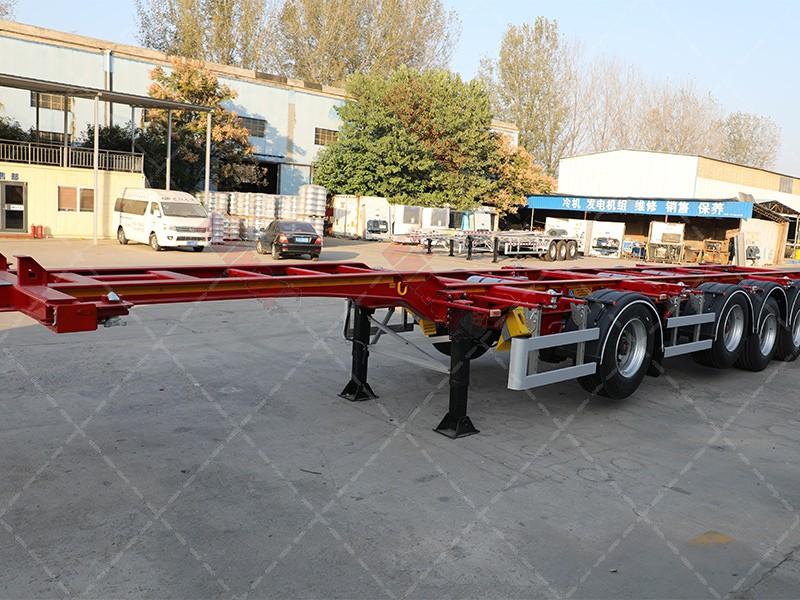





40ft Flatbed Semi Trailer: The Ultimate Guide to Buying, Specs, and Global Applications
 Jun 29, 2026|
 View:512
When you search for a 40ft flatbed semi trailer, you are looking at the most versatile workhorse in the heavy-haul industry. Whether you're transporting steel coils, construction lumber, wind turbine components, or containerized cargo, the 40-foot platform remains the global standard for over-dimensional and general freight.
In this comprehensive guide, we cover everything a fleet manager, owner-operator, or procurement specialist needs to know before investing in a 40ft flatbed semi trailer: from structural design and axle configurations to compliance certifications and cost-saving tips when sourcing from China.
Why Choose a 40ft Flatbed Semi Trailer Over Other Lengths?
The 40ft flatbed semi trailer strikes the perfect balance between payload capacity and maneuverability. Unlike 48ft or 53ft trailers common in North America, the 40-foot length offers:
Better turning radius – ideal for urban delivery, job sites, and tight warehouse docks.
Higher legal payload in many countries – shorter trailer means more weight can be distributed across fewer axles while staying under gross vehicle weight limits.
Container compatibility – 40ft flatbeds directly match ISO shipping container dimensions, making them perfect for break-bulk and RoRo operations.
Easier registration – many markets (Australia, Middle East, Southeast Asia, Africa) cap maximum trailer length at 40 feet for standard permits.
For these reasons, the 40ft flatbed semi trailer is the top-selling configuration among Chinese trailer manufacturers exporting to over 60 countries.
Key Specifications of a Standard 40ft Flatbed Semi Trailer
Below are typical specifications for a heavy-duty 40ft flatbed semi trailer built by leading Chinese OEMs like Rhinox Vehicle, CIMC, and Shandong factories:
Parameter | Specification |
|---|---|
Overall Length | 12,500 mm (41 ft approx.) |
Deck Length | 12,200 mm (40 ft) |
Deck Width | 2,500 mm (standard) / 2,550 mm (optional) |
Side Height (with stake pockets) | 500 mm – 600 mm |
Axle Configuration | 3 axles (tandem + single) or 2 axles |
Tire Size | 12R22.5 radial tubeless |
Suspension Type | Mechanical leaf spring or air ride |
Brake System | Dual-line air brake with ABS (optional EBS) |
Landing Gear | JOST or equivalent, 28-ton static load |
Kingpin | 2-inch (50mm) or 3.5-inch (90mm) according to market |
Payload Capacity | 30 – 45 tons depending on axle count & material |
Tare Weight | Approx. 5,500 – 7,000 kg |
Main Beam Steel | Q345B / T700 high-strength steel |
Note: Always verify with your supplier whether the trailer meets your local road transport regulations regarding width, overhang, and axle spacing.
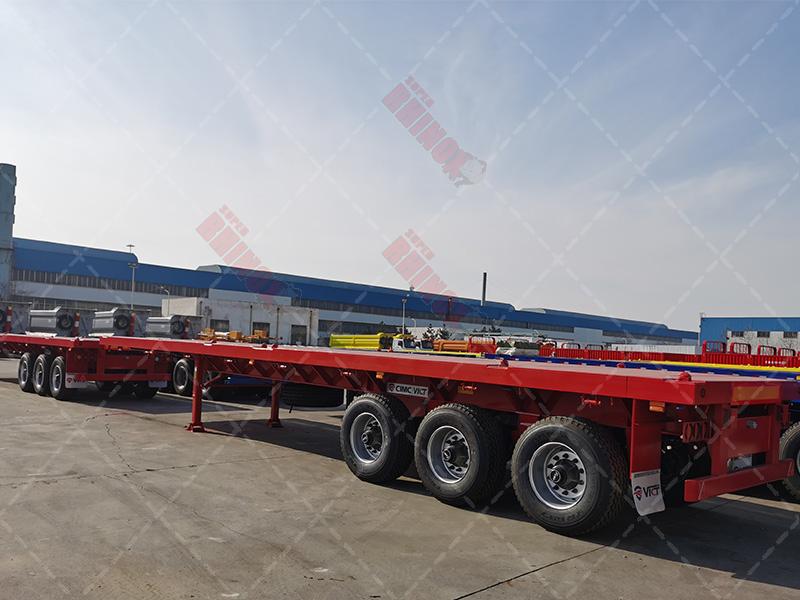
Structural Design: What Makes a 40ft Flatbed Strong Enough for Heavy Hauling?
A quality 40ft flatbed semi trailer uses two main longitudinal I-beams running the full deck length. These beams are typically fabricated from T700 high-strength steel (yield strength ≥ 700 MPa), which allows:
Reduced tare weight without compromising load capacity.
Better resistance to bending fatigue during repeated heavy loading cycles.
Longer service life even under extreme conditions (mining, logging, oilfield).
Cross members are welded at intervals of 300–400 mm, supporting a hardwood or steel floor. Many Chinese manufacturers now offer anti-corrosion treatment (shot blasting + epoxy primer + polyurethane topcoat) as standard, critical for coastal or humid environments.
Axle Configurations Explained
3-Axle 40ft Flatbed Semi Trailer (Most Common)
This is the default configuration for 40ft flatbed semi trailer exports. It provides:
Maximum legal payload of 35–45 tons.
Better weight distribution per axle (≤ 12 tons per axle group in most regions).
Suitable for steel coils, machinery, bulk cement bags, and general cargo.
2-Axle 40ft Flatbed Semi Trailer
Preferred where axle taxes are high (e.g., some European routes) or where GVWR is limited. Payload drops to around 25–30 tons but reduces tire wear and fuel consumption.
4-Axle 40ft Flatbed Semi Trailer
Used exclusively in heavy-haul markets like Australia (road trains) or South Africa. Requires special permit for overall length.
Compliance Certifications You Must Check
Before purchasing any 40ft flatbed semi trailer from overseas suppliers, confirm these certifications:
Market | Required Certification |
|---|---|
USA / Canada | DOT / FMVSS compliance, NHTSA VIN registration |
Europe | ECE R55 (mechanical couplings), ECE R13 (brakes) |
Australia | ADR (Australian Design Rules), NTC mass & dimension |
Middle East / GCC | SASO / ESMA conformity |
Africa | SABS (South Africa) or country-specific type approval |
Many Chinese manufacturers now offer dual-certified trailers (e.g., ADR + CE) to serve multiple export destinations. Ask for a copy of the test report or certificate before placing an order.
Cost Comparison: Sourcing a 40ft Flatbed Semi Trailer from China vs. Local Production
One of the biggest advantages of importing a 40ft flatbed semi trailer from China is the price-to-quality ratio. Below is a rough comparison based on current market data (2025–2026):
Origin | Typical FOB Price (USD) | Lead Time | Warranty |
|---|---|---|---|
China (direct factory) | $8,500 – $14,000 | 15–30 days | 12–24 months |
India | $9,000 – $13,000 | 20–40 days | 12 months |
Turkey | $12,000 – $18,000 | 30–45 days | 12 months |
USA / EU (domestic brand) | $25,000 – $45,000 | 8–16 weeks | 12–36 months |
Note: Prices exclude ocean freight, import duties, and local modifications. However, even after adding logistics costs (approx. $2,000–$4,000 to major ports), Chinese-made 40ft flatbed semi trailers remain highly competitive.
Common Questions Buyers Ask About 40ft Flatbed Semi Trailers
Q: Can a 40ft flatbed semi trailer carry a 40ft shipping container?
Yes, provided the trailer has twist locks installed and the deck width matches the container footprint. Many Chinese models come pre-drilled for twist lock installation.
Q: What is the maximum width allowed for a 40ft flatbed?
Standard width is 2.5 meters (98 inches). Some countries allow 2.55 meters (100 inches) for refrigerated or insulated bodies. Always check local regulations first.
Q: How long does a Chinese 40ft flatbed last?
With proper maintenance (annual inspection, rust prevention, bearing greasing), a well-built trailer can last 10–15 years in normal operation. High-strength steel frames often outlast the first set of tires and brakes.
Q: Is it better to buy a used 40ft flatbed from USA or new from China?
If budget allows, a new Chinese trailer often comes with modern features (LED lights, ABS, air ride) that older US units lack. Plus, you get a full warranty instead of inheriting hidden wear.